The products on this site are sold strictly for laboratory and research use only. They are not for human or animal consumption and are not drugs, supplements, or medical devices. By entering, you confirm that you are at least 21 years of age and a qualified researcher or authorized representative of a research entity, that you are purchasing solely for lawful research-use-only purposes, and that you agree to our Terms and Research-Use Disclaimer. You accept sole responsibility for complying with all applicable laws in your jurisdiction. If you do not meet these requirements or do not agree, please exit.
Email is optional. Add it for 15% off your first order — or just tap Enter below. We'll never sell or share it.
Looking for more laboratory research materials?
Browse the full catalog →
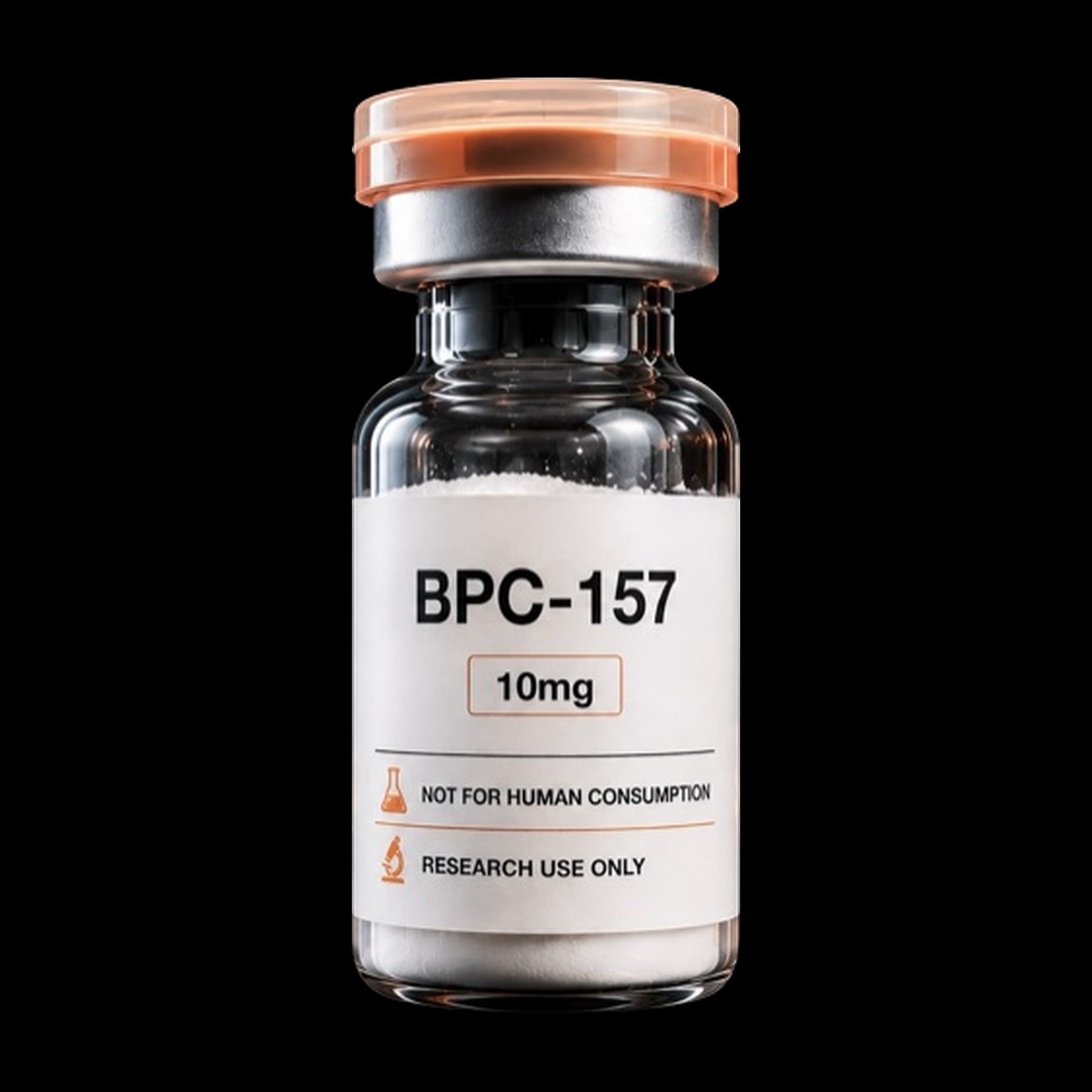
BPC-157 (Body Protection Compound-157) is supplied as a 10mg lyophilized powder in a sealed vial for qualified in-vitro laboratory research. It is one of the most frequently studied research peptides in tissue-repair and gastrointestinal literature. Each lot is third-party HPLC-tested — this lot at 99.69% purity — with a lot-specific Certificate of Analysis, and reconstitutes with bacteriostatic water. Not for human or animal consumption. Research use only.
| Sequence | GEPPPGKPADDAGLV |
|---|---|
| Molecular formula | C62H98N16O22 |
| Average molecular weight | 1419.5 g/mol |
| CAS number | 137525-51-0 |
| PubChem CID | 9941957 |
| Form | Lyophilized powder, 10mg per vial |
| Purity (current lot) | 99.69% (HPLC, third-party) |
BPC-157 is a synthetic linear peptide of 15 amino acids with the sequence GEPPPGKPADDAGLV. The name stands for Body Protection Compound 157. The sequence is a partial fragment of a larger protein first isolated from human gastric juice, and much of the literature calls it a stable gastric pentadecapeptide [1,2].
With an average molecular weight of 1419.5 g/mol, no disulfide bonds and only standard amino acids, it is simple to synthesize and to characterize by HPLC and mass spectrometry. That accessibility, combined with rodent and cell-culture work published from 1993 onward, makes it one of the most frequently referenced peptides in preclinical tissue-repair literature [3]. It has not been approved by the FDA or other regulatory authorities, a point that recent reviews consistently stress [1].
Most BPC-157 data come from animal models. A 2025 literature and patent review summarized preclinical studies in models of tissue injury, inflammatory bowel conditions and central nervous system disorders, and noted that comprehensive clinical studies are still missing [1]. A systematic review from the same year screened 544 records and kept 36 musculoskeletal studies, of which 35 were preclinical and one was clinical [3].
Tendon work is among the best characterized. In a 2003 rat study of transected Achilles tendon, investigators reported biomechanical, functional and histological differences between BPC-157 and saline groups. In culture, the peptide counteracted the growth-inhibiting effect of 4-hydroxynonenal on tendocytes [4]. A 2011 in-vitro study with rat tendon fibroblasts found no direct effect on proliferation but observed more migration, spreading and survival under hydrogen peroxide stress, along with FAK and paxillin phosphorylation [2].
Reviews describe proposed involvement of VEGFR2, the Akt-eNOS nitric oxide axis and ERK1/2 signaling, inferred largely from preclinical studies [5]. Human data remain very limited. A 2025 narrative review counted three small pilot studies and concluded that BPC-157 should be considered investigational until well-designed clinical trials are done [5]. The systematic review reported a half-life under 30 minutes with hepatic metabolism and renal clearance, and found no clinical data on adverse effects [3].
Summaries describe published laboratory and clinical literature for context only. NovaForge Labs materials are sold strictly for in-vitro research and are not intended for human or animal use.
BPC-157 ships as a lyophilized solid, the most stable form for a peptide of this size. Keep sealed vials cold, dry and away from direct light, and let a vial reach room temperature before opening so condensation does not form on the powder. Once a solution is prepared for an assay, standard practice is refrigerated storage, aseptic technique and a short, documented use window. Record the lot number with every experiment.
Yes, these names describe the same 15-residue sequence, GEPPPGKPADDAGLV. Older papers also use the development codes PL 14736 and PLD-116. Our material matches that sequence, with an average molecular weight of 1419.5 g/mol and CAS 137525-51-0, and is supplied only as a reference material for in-vitro research.
Each lot is tested by an independent laboratory, using HPLC for purity and an identity test (LC-MS or an HPLC match against a reference standard, depending on the lab). The current lot measured 99.69% by HPLC. The lot number is listed in your order confirmation email, and entering it on our lot-verification page brings up the matching certificate of analysis.
Published work centers on rodent models of tendon, ligament, muscle and bone injury, gastrointestinal lesion models, some central nervous system models, and cell-culture studies of fibroblast migration. Nearly all of it is preclinical, and only a few small human pilot studies exist.
Keep sealed lyophilized vials refrigerated or frozen, protected from light and moisture. Freezer storage is the usual choice for longer holding periods. Avoid repeated temperature swings that can cause condensation, and keep the vial in its labeled packaging so the lot number stays linked to its certificate of analysis.
Background reading on The Peptide Review:
Store lyophilized material in a cool, dry place away from light. For long-term storage, store at -20°C. Once reconstituted in solution for laboratory use, refrigerate at 2–8°C and use within the appropriate timeframe. Handle only in an appropriate laboratory setting by personnel trained in the safe handling of research chemicals.
For in-vitro laboratory research use only. Not for human or animal consumption. Not a drug, dietary supplement, food, cosmetic, or medical device. Not evaluated or approved by the FDA or any regulatory authority for safety or efficacy in humans or animals. By purchasing, you confirm you are 21 years of age or older and a qualified researcher (or authorized representative of a research entity) purchasing solely for lawful in-vitro laboratory research. See our Terms & Research-Use Disclaimer.
We ship Monday–Friday with a 1:00 PM PST cutoff; orders with confirmed payment before the cutoff ship the same business day. Orders ship in plain, discreet, tamper-evident packaging with tracking. Free shipping on orders over $200. All sales are final — refunds or exchanges only if purity is below 99%. See our full Shipping & Returns Policy.
All products offered by NovaForge Labs are strictly intended for laboratory research purposes only. These products are not approved by the FDA and are not intended for human or animal consumption, diagnostic use, or therapeutic application. No medical advice, health claims, or dosing recommendations are made or implied. Purchasers must be 21 years of age or older and must be licensed research professionals conducting in-vitro laboratory studies. By purchasing from NovaForge Labs, you confirm that you understand and agree to these terms.
Products are sold strictly for laboratory research use only and are not for human or animal consumption. A Certificate of Analysis is available for every lot.
Order 2 or more items and get 20% off instead.
Enter your email and we'll alert you the moment it's back in stock — plus the occasional offer. No spam, unsubscribe anytime.