The products on this site are sold strictly for laboratory and research use only. They are not for human or animal consumption and are not drugs, supplements, or medical devices. By entering, you confirm that you are at least 21 years of age and a qualified researcher or authorized representative of a research entity, that you are purchasing solely for lawful research-use-only purposes, and that you agree to our Terms and Research-Use Disclaimer. You accept sole responsibility for complying with all applicable laws in your jurisdiction. If you do not meet these requirements or do not agree, please exit.
Email is optional. Add it for 15% off your first order — or just tap Enter below. We'll never sell or share it.
Looking for more laboratory research materials?
Browse the full catalog →
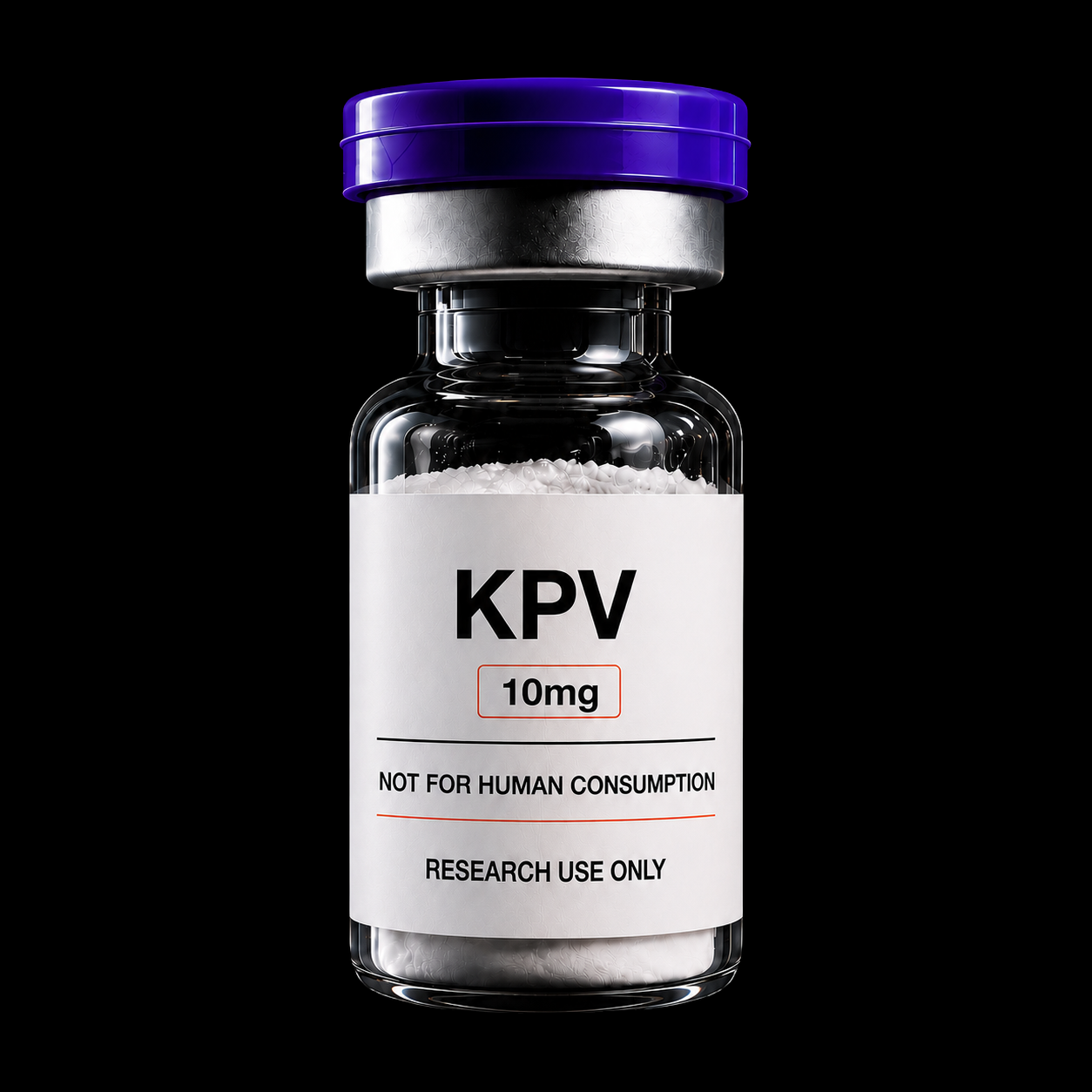
KPV (Lysine-Proline-Valine) is a research tripeptide supplied as a 10mg lyophilized powder in a sealed vial for qualified in-vitro laboratory research. It reconstitutes with bacteriostatic water. Not for human or animal consumption. Research use only.
| Sequence | KPV (Lys-Pro-Val) |
|---|---|
| Molecular formula | C16H30N4O4 |
| Average molecular weight | 342.43 g/mol |
| CAS number | 67727-97-3 |
| PubChem CID | 125672 |
| Form | Lyophilized powder, 10mg per vial |
| Purity (current lot) | COA for the current lot not yet published |
KPV is the tripeptide lysine-proline-valine, matching residues 11 to 13 at the C-terminus of alpha-melanocyte-stimulating hormone (α-MSH). It lacks the sequence motif α-MSH uses to bind known melanocortin receptors, yet reviews report that it retains much of the parent hormone's activity in inflammation models without its pigment-related effects [1].
At an average molecular weight of 342.43 g/mol, KPV is one of the smallest peptides in routine research use. Its short length makes it easy to synthesize and quantify. Cell studies showed that it is taken up by PepT1, the di- and tripeptide transporter of the intestinal lining, which helps explain why so much KPV work focuses on the gut [2]. Researchers often compare it side by side with full-length α-MSH and modified analogs.
A 2003 mouse study compared KPV with α-MSH and other melanocortin peptides in crystal-induced peritonitis. KPV reduced leukocyte accumulation, but unlike α-MSH it did not raise cAMP in macrophages, and a melanocortin 3/4 receptor antagonist did not block its effect. The authors proposed that it acts outside melanocortin receptors, possibly by interfering with IL-1β [3].
Intestinal models make up the largest share of KPV research. In human intestinal epithelial and T-cell lines, nanomolar KPV reduced NF-κB and MAP kinase activation and cytokine secretion, and its uptake depended on PepT1. The same paper reported lower inflammatory markers in DSS- and TNBS-induced mouse colitis [2]. A separate 2008 study found fewer inflammatory infiltrates and lower myeloperoxidase activity in two mouse colitis models, including mice lacking a functional MC1 receptor [4].
Analytical methods are published too. A validated, stability-indicating reversed-phase HPLC assay separated KPV from its degradation products, and under acid, alkali and peroxide stress the main degradant was a lysine-proline diketopiperazine [5]. A 2010 review noted that the exact intracellular signaling route for KPV is still unknown [1]. All of the sources cited on this page describe preclinical work.
Summaries describe published laboratory and clinical literature for context only. NovaForge Labs materials are sold strictly for in-vitro research and are not intended for human or animal use.
Because KPV lacks the motif full-length alpha-MSH uses to bind melanocortin receptors, studies of one should not be read as describing the other [1].
| KPV (this product) | Alpha-MSH | |
|---|---|---|
| Length | 3 residues (Lys-Pro-Val) | 13 residues |
| Relationship | C-terminal positions 11-13 of alpha-MSH | Full-length melanocortin peptide |
| Average molecular weight | 342.43 g/mol | about 1665 g/mol |
| Core melanocortin-receptor motif (His-Phe-Arg-Trp) | Absent | Present |
KPV is supplied lyophilized and should be kept sealed, cold, dry and out of light. Published stress testing found that the tripeptide degrades under strongly acidic, alkaline and oxidizing conditions, forming a diketopiperazine [5], so freshly prepared, near-neutral solutions are the practical choice. Warm vials to room temperature before opening, limit freeze-thaw cycles and note the lot number in your records.
Each sealed vial contains 10mg of lyophilized KPV, the tripeptide Lys-Pro-Val (CAS 67727-97-3). Purity is measured per lot by an independent laboratory, and the figure for your lot is on its lot-specific certificate of analysis.
No. KdPT is a related tripeptide derivative described in the α-MSH literature, and several dimeric and modified KPV analogs have also been reported. They differ in structure and mass. This product is the unmodified linear tripeptide Lys-Pro-Val, CAS 67727-97-3.
KPV is the final three amino acids of alpha-melanocyte-stimulating hormone, positions 11 to 13. It lacks the motif full-length α-MSH uses to bind melanocortin receptors, and published mouse studies suggest its activity in inflammation models runs at least partly through other pathways.
Not yet. The certificate of analysis for the KPV lot currently in stock has not been published, so we do not state a purity figure for it. When the lot certificate is available it will be linked here and on our lot-verification page. The expected average mass of KPV is 342.43 g/mol, a useful identity check on any certificate.
Mostly mouse models of colitis and peritonitis, plus human intestinal epithelial and T-cell lines. Studies have examined NF-κB signaling, cytokine release and PepT1-mediated uptake. The literature is preclinical, and this material is sold only for qualified in-vitro laboratory research.
Background reading on The Peptide Review:
Store lyophilized material in a cool, dry place away from light. For long-term storage, store at -20°C. Once reconstituted in solution for laboratory use, refrigerate at 2–8°C and use within the appropriate timeframe. Handle only in an appropriate laboratory setting by personnel trained in the safe handling of research chemicals.
For in-vitro laboratory research use only. Not for human or animal consumption. Not a drug, dietary supplement, food, cosmetic, or medical device. Not evaluated or approved by the FDA or any regulatory authority for safety or efficacy in humans or animals. By purchasing, you confirm you are 21 years of age or older and a qualified researcher (or authorized representative of a research entity) purchasing solely for lawful in-vitro laboratory research. See our Terms & Research-Use Disclaimer. See our Research Use Agreement.
We ship Monday–Friday with a 1:00 PM PST cutoff; orders with confirmed payment before the cutoff ship the same business day. Orders ship in a plain black bubble mailer with tracking, with no product details on the outside. Free shipping on orders over $200. All sales are final — refunds or exchanges only if purity is below 99%. See our full Shipping & Returns Policy.
Order 2 or more items and get 20% off instead.
Enter your email and we'll alert you the moment it's back in stock — plus the occasional offer. No spam, unsubscribe anytime.