The products on this site are sold strictly for laboratory and research use only. They are not for human or animal consumption and are not drugs, supplements, or medical devices. By entering, you confirm that you are at least 21 years of age and a qualified researcher or authorized representative of a research entity, that you are purchasing solely for lawful research-use-only purposes, and that you agree to our Terms and Research-Use Disclaimer. You accept sole responsibility for complying with all applicable laws in your jurisdiction. If you do not meet these requirements or do not agree, please exit.
Email is optional. Add it for 15% off your first order — or just tap Enter below. We'll never sell or share it.
Looking for more laboratory research materials?
Browse the full catalog →
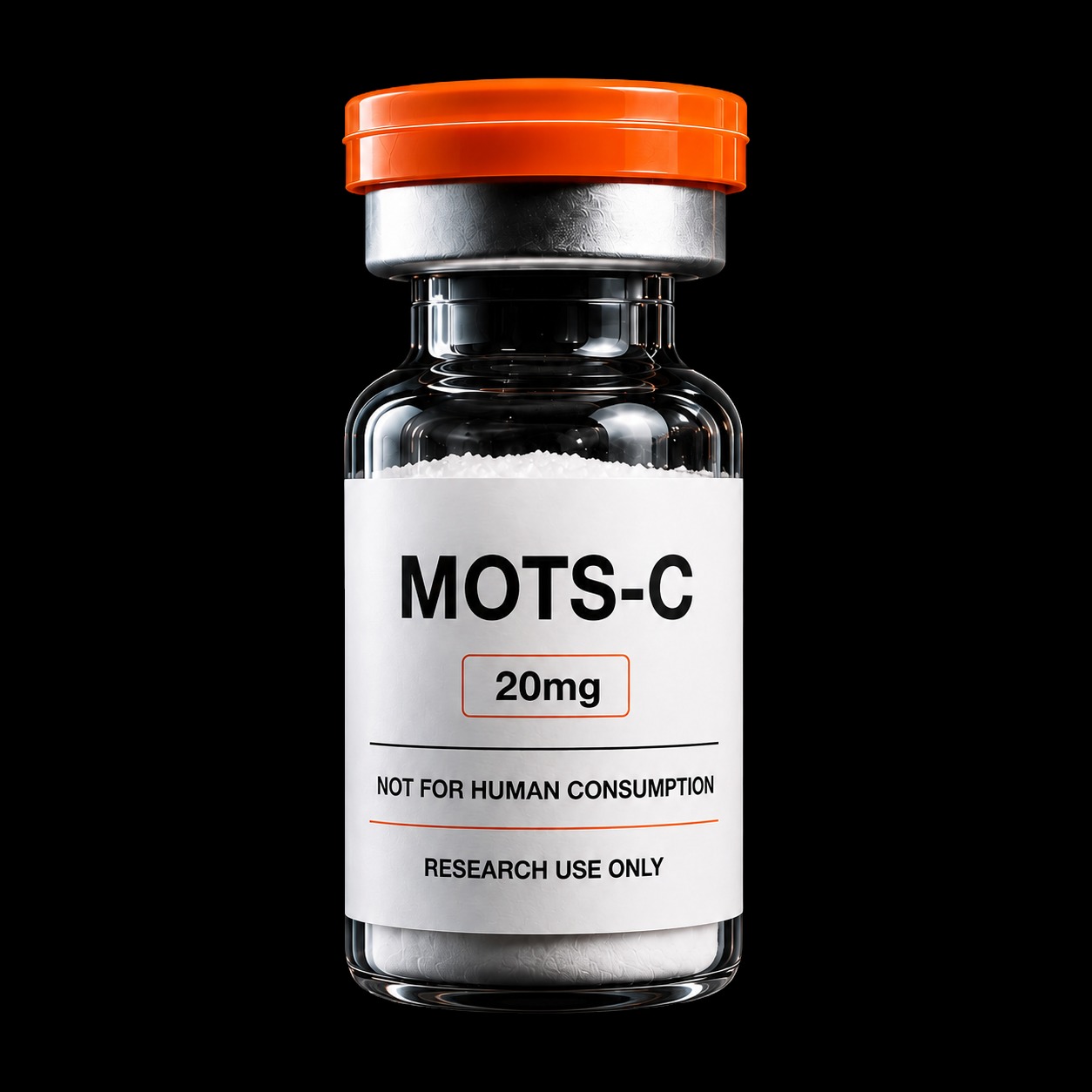
MOTS-c is a mitochondrial-derived peptide supplied as a 20mg lyophilized powder in a sealed vial for qualified in-vitro laboratory research. Each lot is third-party HPLC-tested — this lot at 99.86% purity — with a lot-specific Certificate of Analysis, and reconstitutes with bacteriostatic water. Not for human or animal consumption. Research use only.
| Sequence | MRWQEMGYIFYPRKLR |
|---|---|
| Molecular formula | C101H152N28O22S2 |
| Average molecular weight | 2174.6 g/mol |
| CAS number | 1627580-64-6 |
| PubChem CID | 146675088 |
| Form | Lyophilized powder, 20mg per vial |
| Purity (current lot) | 99.86% (HPLC, third-party) |
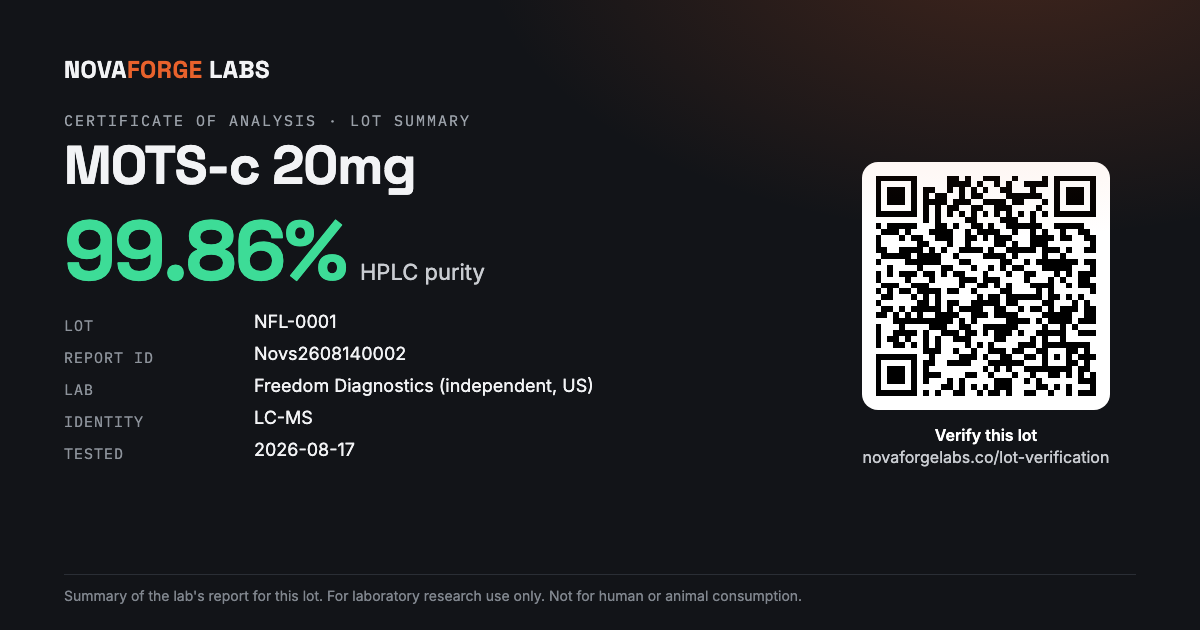
Each card summarizes the independent lab report for a lot currently in stock. Look up your own lot on the lot verification page.
| Appearance | Lyophilized powder in a sealed vial |
|---|---|
| Labeled fill | 20mg |
| Counter-ion / salt form | Stated on the lot COA |
| Storage (unopened) | Cool, dry and dark; -20°C for long-term holding |
| Purity (current lot) | 99.86% (HPLC, third-party) |
MOTS-c stands for mitochondrial open reading frame of the 12S rRNA type-c. It is a 16-residue peptide encoded by a short open reading frame inside the mitochondrial 12S ribosomal RNA gene, not by nuclear DNA. Its sequence, MRWQEMGYIFYPRKLR, was first described in 2015 [1], and it belongs to a small family of mitochondrial-derived peptides that also includes humanin.
The material in this vial is a synthetic copy of that sequence, supplied as a lyophilized solid for in-vitro laboratory work. MOTS-c draws research interest because it challenges a long-held assumption: that signaling between mitochondria and the nucleus runs mostly one way. Work on this peptide asks how a molecule encoded in the mitochondrial genome might take part in nuclear gene regulation, which makes it a common reference compound in mitochondrial biology and metabolism labs.
The founding 2015 study identified MOTS-c and reported that, in mice, it acted mainly on skeletal myocytes, inhibited folate-dependent one-carbon metabolism and de novo purine synthesis, and activated AMPK. The same paper described effects on insulin sensitivity in mice fed a high-fat diet [1].
A 2018 follow-up in cultured cells showed that MOTS-c moved into the nucleus during metabolic stress such as glucose restriction, in an AMPK-dependent way, and interacted with stress-responsive transcription factors including NRF2 [2]. In-vitro work using human and murine myoblast (myogenic progenitor) cell lines reported increased myotube formation and linked this to reduced STAT3 activity through a YIFY motif in the sequence [3].
A 2021 study examined physical capacity in young, middle-aged and old mice given MOTS-c, and also measured endogenous MOTS-c in people, finding that exercise raised its levels in skeletal myofiber tissue and in circulation [4]. That human finding concerns the body's own peptide, not administered material.
A 2023 review summarizes the wider literature, which spans aging, cardiovascular disease, insulin resistance and inflammation, and notes that plasma MOTS-c levels appear to decline with age [5]. The evidence base remains largely preclinical, and the review states that no established clinical application has been developed.
Summaries describe published laboratory and clinical literature for context only. NovaForge Labs materials are sold strictly for in-vitro research and are not intended for human or animal use.
Three numbers describe a vial and they measure different things. The labeled fill (20mg) is the amount of material the vial is filled to. HPLC purity (99.86% for the current lot) is the share of the UV-detected signal that belongs to MOTS-c. Net peptide content is the share of the weighed powder that is peptide, after counter-ions and residual water. A peptide of this size is usually isolated as a salt, so net content is normally below the labeled fill.
Keep the sealed vial cold, dry and away from light until use. The sequence contains two methionine residues and one tryptophan, which are among the residues most prone to oxidation, so limit repeated exposure to air and moisture. Let the vial reach room temperature before opening to avoid condensation. Once in solution, general practice is to aliquot, refrigerate or freeze, and avoid repeated freeze-thaw cycling.
Yes, in origin. Both are mitochondrial-derived peptides encoded by short open reading frames in mitochondrial DNA. Humanin was the first of these to be reported, and the 2015 study describing MOTS-c built on that discovery. The two have different sequences and lengths and are studied as separate compounds.
Each lot is tested by an independent laboratory using HPLC for purity and an identity test (LC-MS or an HPLC match against a reference standard, depending on the lab). The current lot measured 99.86% by HPLC. The certificate of analysis is tied to the lot number, and you can confirm that number on our lot-verification page.
The expected average molecular weight of MOTS-c is 2174.6 g/mol for the formula C101H152N28O22S2. Mass spectrometry data on the certificate should fall close to this value, allowing for the charge states and ionization method the testing laboratory reports.
The literature we reviewed is preclinical, built on cell culture and rodent studies, plus human measurements of the body's own MOTS-c levels. This product is a research reference material for in-vitro use only and is not intended for people or animals.
No, 20mg is the labeled fill. Net peptide content is lower because the powder also contains counter-ions and residual water. It is reported only when a lab runs a net-content test, so check the certificate of analysis for your lot.
It is supplied as a lyophilized powder in a sealed 20mg vial. The salt form for each lot is listed on its certificate of analysis.
Background reading on The Peptide Review:
Store lyophilized material in a cool, dry place away from light. For long-term storage, store at -20°C. Once reconstituted in solution for laboratory use, refrigerate at 2–8°C and use within the appropriate timeframe. Handle only in an appropriate laboratory setting by personnel trained in the safe handling of research chemicals.
For in-vitro laboratory research use only. Not for human or animal consumption. Not a drug, dietary supplement, food, cosmetic, or medical device. Not evaluated or approved by the FDA or any regulatory authority for safety or efficacy in humans or animals. By purchasing, you confirm you are 21 years of age or older and a qualified researcher (or authorized representative of a research entity) purchasing solely for lawful in-vitro laboratory research. See our Terms & Research-Use Disclaimer. See our Research Use Agreement.
We ship Monday–Friday with a 1:00 PM PST cutoff; orders with confirmed payment before the cutoff ship the same business day. Orders ship in a plain black bubble mailer with tracking, with no product details on the outside. Free shipping on orders over $200. All sales are final — refunds or exchanges only if purity is below 99%. See our full Shipping & Returns Policy.
Order 2 or more items and get 20% off instead.
Enter your email and we'll alert you the moment it's back in stock — plus the occasional offer. No spam, unsubscribe anytime.