The products on this site are sold strictly for laboratory and research use only. They are not for human or animal consumption and are not drugs, supplements, or medical devices. By entering, you confirm that you are at least 21 years of age and a qualified researcher or authorized representative of a research entity, that you are purchasing solely for lawful research-use-only purposes, and that you agree to our Terms and Research-Use Disclaimer. You accept sole responsibility for complying with all applicable laws in your jurisdiction. If you do not meet these requirements or do not agree, please exit.
Email is optional. Add it for 15% off your first order — or just tap Enter below. We'll never sell or share it.
Looking for more laboratory research materials?
Browse the full catalog →
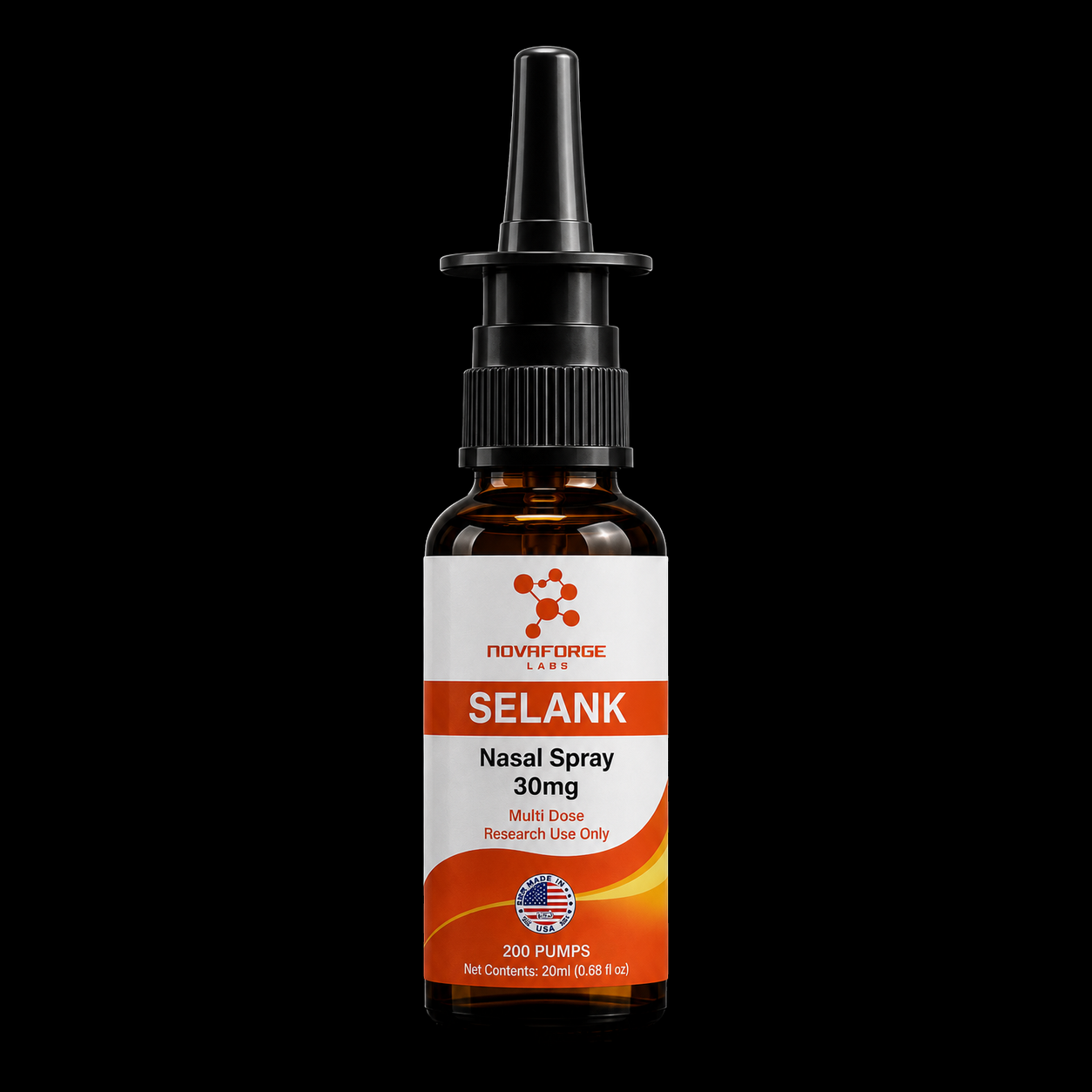
Selank is a research peptide (a Tuftsin analogue) supplied as a 30mg nasal spray reference presentation for qualified in-vitro laboratory research. Each lot is third-party HPLC-tested — this lot at 99.94% purity — with a lot-specific Certificate of Analysis. Not for human or animal consumption. Research use only.
| Sequence | TKPRPGP (Thr-Lys-Pro-Arg-Pro-Gly-Pro) |
|---|---|
| Also known as | Tuftsin analogue |
| Molecular formula | C33H57N11O9 |
| Average molecular weight | 751.9 g/mol |
| CAS number | 129954-34-3 |
| PubChem CID | 11765600 |
| Form | Nasal spray reference presentation, 30mg |
| Purity (current lot) | 99.94% (HPLC, third-party) |
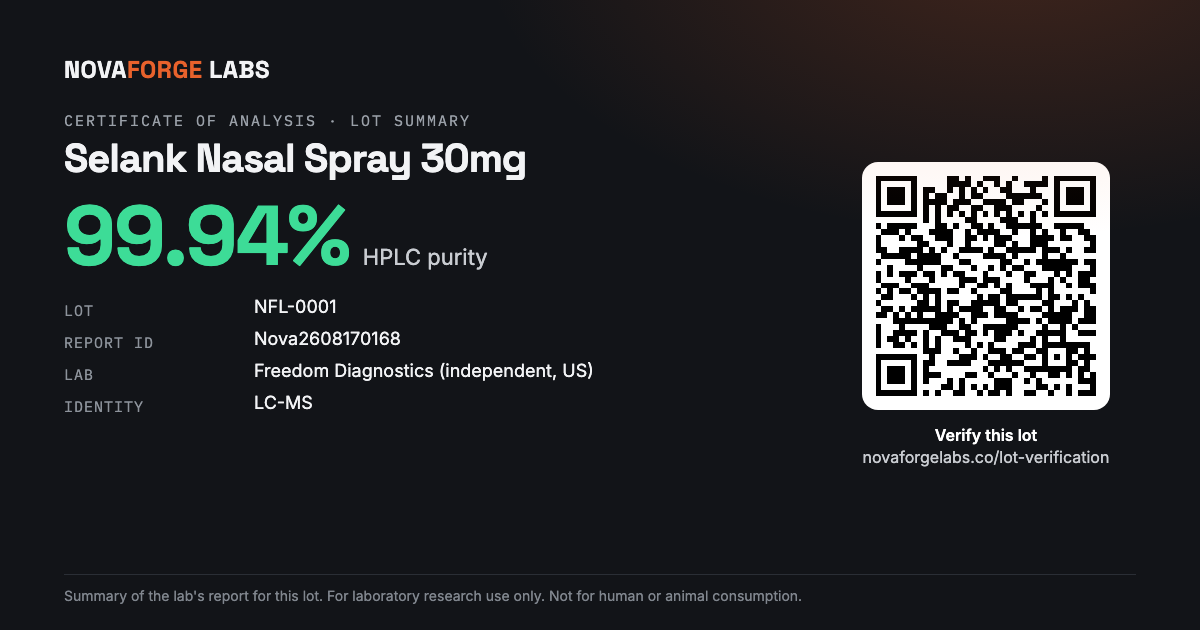
Each card summarizes the independent lab report for a lot currently in stock. Look up your own lot on the lot verification page.
The nasal spray bottle is the presentation format this material ships in. Selank is sold for in-vitro laboratory research only and is not for human or animal use.
| Total peptide | 30mg Selank per bottle |
|---|---|
| Presentation | Multi-dose nasal spray bottle, supplied as a solution |
| Storage | Unopened: cool, dry, away from light. Opened: refrigerate at 2–8°C, capped |
| Purity (current lot) | 99.94% (HPLC, third-party) |
Selank is a synthetic heptapeptide based on tuftsin, a naturally occurring tetrapeptide (Thr-Lys-Pro-Arg) first described as an immunomodulator. Selank extends the tuftsin sequence with a C-terminal Pro-Gly-Pro, the same stabilizing tripeptide used in Semax, which slows enzymatic breakdown compared with tuftsin alone.
It was developed at the Institute of Molecular Genetics of the Russian Academy of Sciences, and most of its literature comes from that group and collaborating labs. Research has concentrated on two areas: how Selank interacts with GABAergic signaling and how it influences the expression of genes linked to inflammation and neurotransmission in rodent and cell models. As with Semax, modified variants exist, so the lot certificate is the reference for identity.
A 2017 review of tuftsin and its analogues summarizes decades of work on the parent tetrapeptide and its derivatives, grouping analogues by the activities studied, including immunomodulatory, antimicrobial and anti-tumor research [1]. Selank is one of the more extensively studied members of that family.
Radioligand binding work on isolated brain cell membranes examined how Selank affects the binding of labelled GABA, as part of an effort to explain its reported activity at the molecular level [2]. In rats, real-time PCR analysis of 84 neurotransmission-related genes in the frontal cortex found changes in the expression of 45 genes one hour after Selank or GABA administration, with a positive correlation between the two compounds' expression profiles [3].
Gene-expression research has also covered inflammation pathways. A 2014 study tracked how the expression of inflammation-related genes changed over time in response to Selank [4]. Taken together, this literature is largely preclinical and mechanistic, and it is the context in which labs use Selank as a reference compound.
Summaries describe published laboratory and clinical literature for context only. NovaForge Labs materials are sold strictly for in-vitro research and are not intended for human or animal use.
| Selank | Semax | |
|---|---|---|
| Parent peptide | Tuftsin (Thr-Lys-Pro-Arg) | ACTH(4-7) fragment |
| Sequence | TKPRPGP | MEHFPGP |
| Average molecular weight | 751.9 g/mol | 813.9 g/mol |
| CAS number | 129954-34-3 | 80714-61-0 |
| Purity (current lot) | 99.94% (HPLC) | 99.43% (HPLC) |
This material is supplied as a nasal spray reference presentation for laboratory characterization. Keep it sealed, upright and refrigerated, away from light and heat. Limit repeated opening to reduce contamination and evaporation. Note the lot number on your records, and discard material that looks cloudy, discolored or contains particles.
Tuftsin is a natural four-residue peptide, Thr-Lys-Pro-Arg, studied for its effects on immune cells. Selank keeps that sequence and adds Pro-Gly-Pro at the end, which makes it more stable against enzymes. It is a synthetic analogue, not tuftsin itself.
Both are heptapeptides ending in Pro-Gly-Pro and both were developed at the same Russian institute. Selank is built on tuftsin, while Semax is built on a fragment of ACTH. Their sequences, molecular weights and research focus are different.
It appears mainly in neuropharmacology studies of GABAergic signaling, gene-expression studies of neurotransmission and inflammation, and analytical work characterizing tuftsin analogues. Most of the literature uses rodent or cell models.
Each lot is tested by an independent laboratory using HPLC for purity and an identity test (LC-MS or an HPLC match against a reference standard, depending on the lab). This lot measured 99.94%. Enter the lot number from your order confirmation on our lot-verification page to view its certificate of analysis.
Much of the published Selank literature studies intranasal application in rodent models, so labs characterizing that format use a nasal spray presentation as their reference material. It is a presentation format only. This product is supplied for in-vitro laboratory research and is not intended for human or animal use.
Not at the moment. We currently stock Selank only as the 30mg nasal spray presentation.
Keep it capped, upright and refrigerated at 2–8°C, away from light. Published stability data for opened peptide sprays is limited, so record the opening date and discard material that turns cloudy, discolored or shows particles.
Background reading on The Peptide Review:
Store lyophilized material in a cool, dry place away from light. For long-term storage, store at -20°C. Once reconstituted in solution for laboratory use, refrigerate at 2–8°C and use within the appropriate timeframe. Handle only in an appropriate laboratory setting by personnel trained in the safe handling of research chemicals.
For in-vitro laboratory research use only. Not for human or animal consumption. Not a drug, dietary supplement, food, cosmetic, or medical device. Not evaluated or approved by the FDA or any regulatory authority for safety or efficacy in humans or animals. By purchasing, you confirm you are 21 years of age or older and a qualified researcher (or authorized representative of a research entity) purchasing solely for lawful in-vitro laboratory research. See our Terms & Research-Use Disclaimer. See our Research Use Agreement.
We ship Monday–Friday with a 1:00 PM PST cutoff; orders with confirmed payment before the cutoff ship the same business day. Orders ship in a plain black bubble mailer with tracking, with no product details on the outside. Free shipping on orders over $200. All sales are final — refunds or exchanges only if purity is below 99%. See our full Shipping & Returns Policy.
Order 2 or more items and get 20% off instead.
Enter your email and we'll alert you the moment it's back in stock — plus the occasional offer. No spam, unsubscribe anytime.