The products on this site are sold strictly for laboratory and research use only. They are not for human or animal consumption and are not drugs, supplements, or medical devices. By entering, you confirm that you are at least 21 years of age and a qualified researcher or authorized representative of a research entity, that you are purchasing solely for lawful research-use-only purposes, and that you agree to our Terms and Research-Use Disclaimer. You accept sole responsibility for complying with all applicable laws in your jurisdiction. If you do not meet these requirements or do not agree, please exit.
Email is optional. Add it for 15% off your first order — or just tap Enter below. We'll never sell or share it.
Looking for more laboratory research materials?
Browse the full catalog →
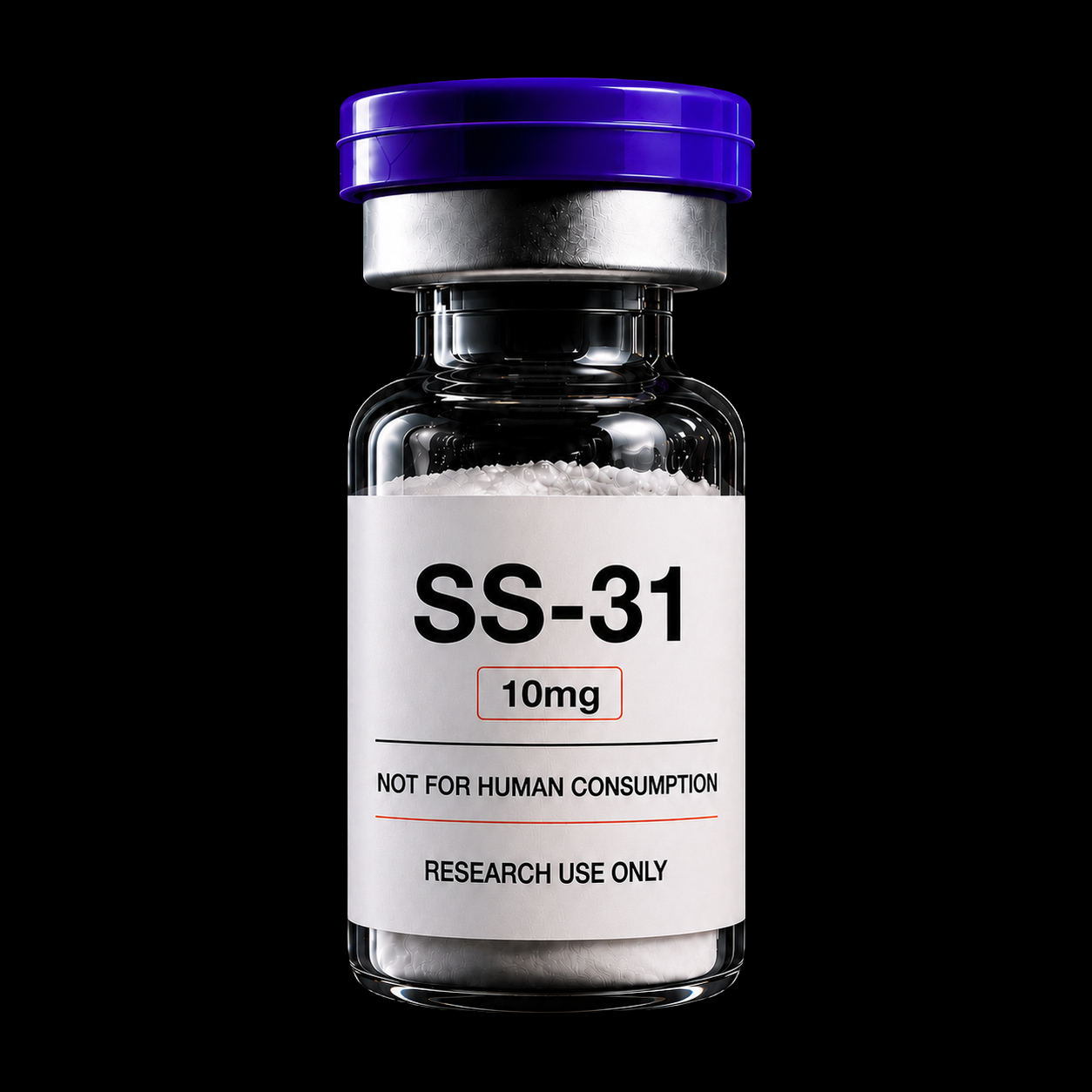
SS-31 (also known as Elamipretide or Szeto-Schiller 31) is a mitochondria-targeting research peptide supplied as a 10mg lyophilized powder in a sealed vial for qualified in-vitro laboratory research. Each lot is third-party HPLC-tested — this lot at 99.89% purity — with a lot-specific Certificate of Analysis, and reconstitutes with bacteriostatic water. Not for human or animal consumption. Research use only.
| Synonyms | Elamipretide; MTP-131; Bendavia |
|---|---|
| Sequence | D-Arg-Dmt-Lys-Phe-NH2 (Dmt = 2,6-dimethyltyrosine) |
| Molecular formula | C32H49N9O5 |
| Average molecular weight | 639.8 g/mol |
| CAS number | 736992-21-5 |
| PubChem CID | 11764719 |
| Form | Lyophilized powder, 10mg per vial |
| Purity (current lot) | 99.89% (HPLC, third-party) |
| Salt form | Stated on the lot COA |
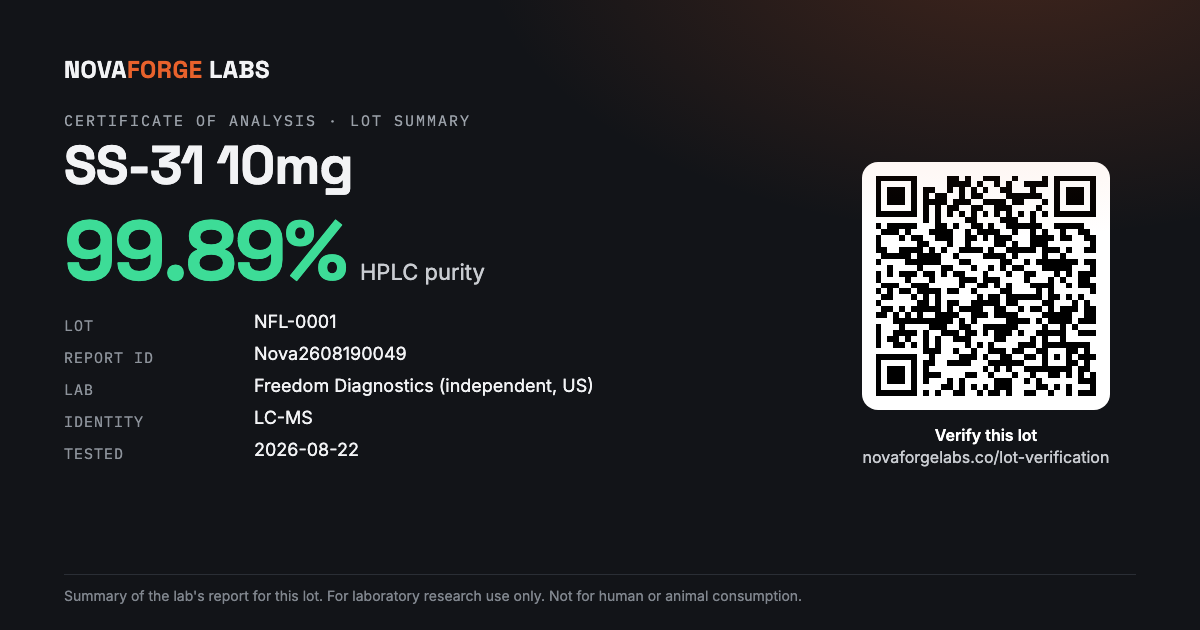
Each card summarizes the independent lab report for a lot currently in stock. Look up your own lot on the lot verification page.
SS-31 is a synthetic tetrapeptide, D-Arg-Dmt-Lys-Phe-NH2, from the Szeto-Schiller family of aromatic-cationic peptides. Its design alternates aromatic residues with basic ones, and it includes two features not found in standard peptides: a D-arginine at the N-terminus and 2,6-dimethyltyrosine (Dmt) in the second position. The C-terminus is amidated.
That structure gives the molecule a net positive charge at physiological pH and lets it enter cells and concentrate at the inner mitochondrial membrane [1]. SS-31 is also known as elamipretide and MTP-131, the names used once it entered pharmaceutical development. It is one of the most widely cited tools in research on mitochondrial membranes, and its short length makes it a convenient model for studying how small peptides interact with lipids such as cardiolipin.
Early work described the SS peptides as cell-permeable compounds that scavenge hydrogen peroxide and peroxynitrite in vitro, inhibit lipid peroxidation, and accumulate more than 1000-fold in the inner mitochondrial membrane [1].
Later studies shifted the focus to cardiolipin, a phospholipid specific to the inner mitochondrial membrane. A 2020 study in rats found that elamipretide limited fragmentation of cristae networks after cardiac ischemia-reperfusion, and showed in biomimetic membranes that it aggregates cardiolipin [2]. A 2025 review summarized more recent findings that elamipretide alters membrane electrostatic potential and the assembly of cardiolipin-dependent proteins, and it reviewed animal models involving cardiac, skeletal myofiber and retinal tissue [3].
Unlike many research peptides, elamipretide has a clinical record. The phase 3 MMPOWER-3 trial in primary mitochondrial myopathy did not meet its primary endpoints [4]. In September 2025, elamipretide (Forzinity) received accelerated approval in the United States for Barth syndrome, a rare genetic disorder, and it remains in development for other conditions [5].
That approved drug is a regulated pharmaceutical product. The material sold here is a research-grade reference peptide for in-vitro laboratory use and is not that drug.
Summaries describe published laboratory and clinical literature for context only. NovaForge Labs materials are sold strictly for in-vitro research and are not intended for human or animal use.
Store the sealed vial cold, dry and protected from light, and let it reach room temperature before opening. SS-31 is highly cationic and is usually supplied as a salt, so the counter-ion contributes to the weighed mass. Account for this when comparing data across lots or suppliers. Its basic residues can adsorb to some glass and plastic surfaces at low concentrations, so low-binding labware is a common choice.
They share the same sequence, D-Arg-Dmt-Lys-Phe-NH2. Elamipretide is the drug name used in clinical development and for the approved product, while SS-31 is the original research code. This vial is a research reference material, not the approved pharmaceutical, and is not for use in people or animals.
Position two is 2,6-dimethyltyrosine, a modified tyrosine. Early descriptions of the SS peptides attribute their antioxidant activity to the tyrosine or dimethyltyrosine residue. The D-arginine at position one is also non-standard and contributes to the peptide's positive charge.
An independent laboratory measures purity by HPLC and identity by LC-MS or an HPLC match against a reference standard. The current lot tested at 99.89%, and the expected average molecular weight is 639.8 g/mol for the free peptide. The certificate of analysis carries the lot number shown on our lot-verification page.
Published work centers on mitochondrial membranes: cardiolipin binding, cristae structure, oxidative stress and bioenergetics. Models include isolated mitochondria, cell culture, and rodent studies of cardiac, skeletal myofiber and retinal tissue. Clinical trials have also been run with elamipretide, separately from any research-grade material.
No. Forzinity is the brand name of an FDA-approved elamipretide drug product, manufactured and labeled for patient care. This vial shares the peptide's identity but is a research reference material sold for qualified in-vitro laboratory research only. It is not a drug product and is not for human or animal use.
Synthetic peptides like SS-31 are typically isolated as a salt, most often acetate or trifluoroacetate (TFA), and the counter-ion for each lot is listed on its certificate of analysis. Salt form matters because the counter-ion and residual water add to the weighed mass, so net peptide content is lower than the labeled fill. Our guide on HPLC purity vs net peptide content covers this.
Background reading on The Peptide Review:
Store lyophilized material in a cool, dry place away from light. For long-term storage, store at -20°C. Once reconstituted in solution for laboratory use, refrigerate at 2–8°C and use within the appropriate timeframe. Handle only in an appropriate laboratory setting by personnel trained in the safe handling of research chemicals.
For in-vitro laboratory research use only. Not for human or animal consumption. Not a drug, dietary supplement, food, cosmetic, or medical device. Not evaluated or approved by the FDA or any regulatory authority for safety or efficacy in humans or animals. By purchasing, you confirm you are 21 years of age or older and a qualified researcher (or authorized representative of a research entity) purchasing solely for lawful in-vitro laboratory research. See our Terms & Research-Use Disclaimer. See our Research Use Agreement.
We ship Monday–Friday with a 1:00 PM PST cutoff; orders with confirmed payment before the cutoff ship the same business day. Orders ship in a plain black bubble mailer with tracking, with no product details on the outside. Free shipping on orders over $200. All sales are final — refunds or exchanges only if purity is below 99%. See our full Shipping & Returns Policy.
Order 2 or more items and get 20% off instead.
Enter your email and we'll alert you the moment it's back in stock — plus the occasional offer. No spam, unsubscribe anytime.