The products on this site are sold strictly for laboratory and research use only. They are not for human or animal consumption and are not drugs, supplements, or medical devices. By entering, you confirm that you are at least 21 years of age and a qualified researcher or authorized representative of a research entity, that you are purchasing solely for lawful research-use-only purposes, and that you agree to our Terms and Research-Use Disclaimer. You accept sole responsibility for complying with all applicable laws in your jurisdiction. If you do not meet these requirements or do not agree, please exit.
Email is optional. Add it for 15% off your first order — or just tap Enter below. We'll never sell or share it.
Looking for more laboratory research materials?
Browse the full catalog →
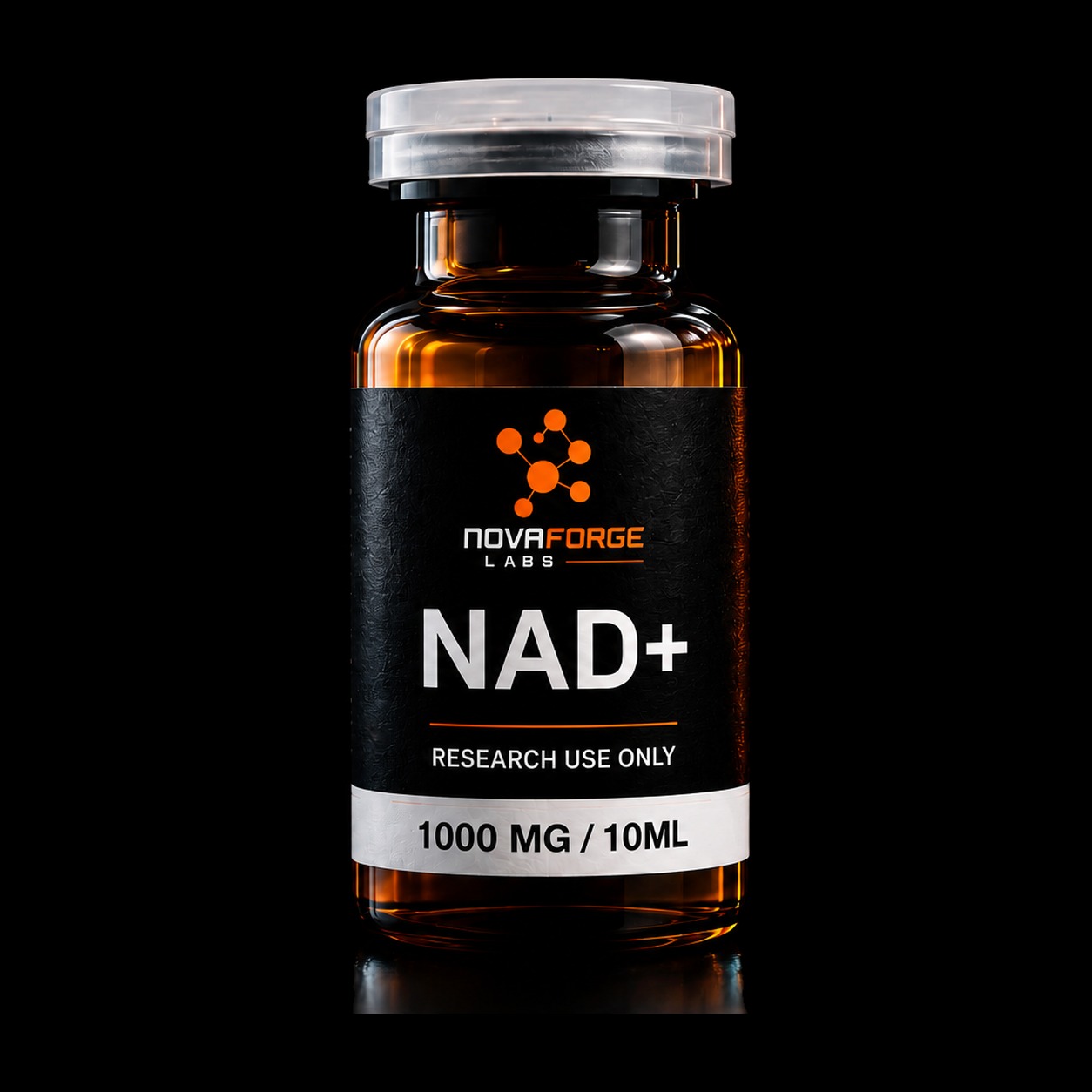
NAD+ (Nicotinamide Adenine Dinucleotide) is supplied as a 1000mg lyophilized white powder in a sealed vial for qualified in-vitro laboratory research. Each lot is third-party tested by HPLC — this lot at 99.98% purity — with a lot-specific Certificate of Analysis, and is reconstituted with bacteriostatic water for laboratory handling. Not for human or animal consumption. Research use only.
| Synonyms | Nicotinamide adenine dinucleotide; nadide |
|---|---|
| Sequence | Not applicable (not a peptide) |
| Molecular formula | C21H27N7O14P2 |
| Average molecular weight | 663.4 g/mol |
| CAS number | 53-84-9 |
| PubChem CID | 5892 |
| Form | Lyophilized powder, 1000mg per vial |
| Purity (current lot) | 99.98% (HPLC, third-party) |
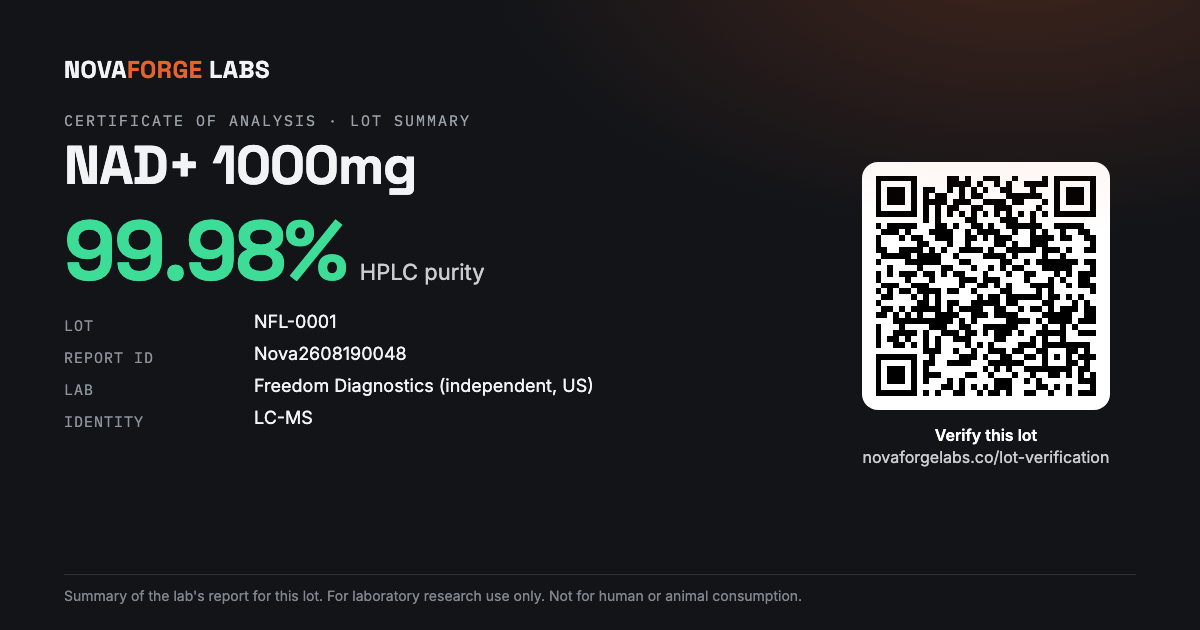
Each card summarizes the independent lab report for a lot currently in stock. Look up your own lot on the lot verification page.
| Labeled fill | 1000mg NAD+ per vial |
|---|---|
| Form | White lyophilized powder in a sealed vial |
| CAS number | 53-84-9 |
| Storage (unopened) | Cool, dry and dark; -20°C for long-term holding |
| Testing | Independent laboratory, HPLC purity per lot |
| Purity (current lot) | 99.98% (HPLC) |
NAD+ is the oxidized form of nicotinamide adenine dinucleotide, a coenzyme present in all living cells. Structurally it is two nucleotides joined through their phosphate groups: one carries adenine and the other carries nicotinamide. It is not a peptide, even though it is often stocked alongside research peptides.
In cells, NAD+ accepts electrons in redox reactions and is reduced to NADH, which places it at the center of energy metabolism. It is also consumed as a substrate by signaling enzymes such as sirtuins and poly(ADP-ribose) polymerases [1]. Because so many pathways draw on the same pool, purified NAD+ is a standard reagent for enzyme assays, metabolic studies and analytical method development. This 1000mg vial gives labs a single, documented lot for a series of experiments.
A 2015 review in Science described NAD+ as both a redox coenzyme and a co-substrate for sirtuins and PARPs, and noted that cellular NAD+ concentrations change with age [1]. A 2021 review expanded the list of NAD+-consuming enzymes to include CD38 and linked NAD+ to DNA repair, chromatin remodeling, senescence and immune cell function. It also reported a gradual fall in tissue NAD+ levels with age across several model organisms, including rodents and humans [2].
Researchers have also revised how dynamic this molecule is. A 2021 perspective reported that NAD has a half-life on the order of minutes in some tissues, and highlighted newer roles such as NAD-capping of RNA, alongside open questions about how NAD and its precursors are transported into cells and organelles [3].
A 2024 review emphasized how much remains uncertain. It discussed unresolved controversies, the influence of the gut microbiome on precursor availability, and non-canonical NAD+ and NADH degradation pathways, and it called for better methods to measure NAD+ within specific cells and compartments [4]. Much of this field rests on cell and animal work, and the review authors are explicit that human questions are still open.
Summaries describe published laboratory and clinical literature for context only. NovaForge Labs materials are sold strictly for in-vitro research and are not intended for human or animal use.
The lot number for your vial is printed in your order-confirmation email. Enter it on our lot-verification page to open the certificate of analysis for that exact lot, including the testing laboratory, method and HPLC purity.
NAD+ powder is hygroscopic, so keep the vial tightly sealed, cold and dry, and let it warm to room temperature before opening. Protect it from light. In solution, NAD+ is generally more stable near neutral to slightly acidic pH than under alkaline conditions, where it degrades faster. Prepare solutions fresh where possible, store aliquots frozen, and verify concentration by UV absorbance if your assay depends on it.
They are two states of the same molecule. NAD+ is the oxidized form that accepts electrons, and NADH is the reduced form that carries them. The NAD+/NADH redox couple is central to how cells maintain redox balance, and shifts in it are studied as markers of redox stress. This product is the oxidized form.
No. NAD+ is a dinucleotide coenzyme made of two nucleotides linked by phosphate groups. It has no amino acid sequence. Peptide suppliers stock it because many metabolism labs use it alongside mitochondrial research peptides such as MOTS-c and SS-31.
An independent laboratory measures purity by HPLC and confirms identity by LC-MS or an HPLC match against a reference standard. The current lot tested at 99.98%. The expected average molecular weight is 663.4 g/mol. Each certificate of analysis is matched to a lot number you can check on our lot-verification page.
Nicotinamide riboside and nicotinamide mononucleotide are smaller molecules that cells convert into NAD+ through biosynthetic pathways, and they are the focus of much current research. This product is NAD+ itself, supplied as a laboratory reference material for in-vitro work.
It is supplied as a lyophilized powder: 1000mg of white, dry NAD+ in a sealed vial. We do not stock a premixed NAD+ solution.
Keep the unopened vial cold, dry and protected from light. For longer holding periods, -20°C is the usual choice. NAD+ powder absorbs moisture, so let the vial reach room temperature before opening and keep it tightly sealed.
1000mg is the labeled fill. HPLC purity (99.98% for the current lot) describes the share of the detected signal that is NAD+, not a weighed mass. Net content can differ slightly because of residual moisture and any counter-ion. Our guide on HPLC purity vs net peptide content explains how these numbers relate.
Background reading on The Peptide Review:
Store lyophilized material in a cool, dry place away from light. For long-term storage, store at -20°C. Once reconstituted in solution for laboratory use, refrigerate at 2–8°C and use within the appropriate timeframe. Handle only in an appropriate laboratory setting by personnel trained in the safe handling of research chemicals.
For in-vitro laboratory research use only. Not for human or animal consumption. Not a drug, dietary supplement, food, cosmetic, or medical device. Not evaluated or approved by the FDA or any regulatory authority for safety or efficacy in humans or animals. By purchasing, you confirm you are 21 years of age or older and a qualified researcher (or authorized representative of a research entity) purchasing solely for lawful in-vitro laboratory research. See our Terms & Research-Use Disclaimer. See our Research Use Agreement.
We ship Monday–Friday with a 1:00 PM PST cutoff; orders with confirmed payment before the cutoff ship the same business day. Orders ship in a plain black bubble mailer with tracking, with no product details on the outside. Free shipping on orders over $200. All sales are final — refunds or exchanges only if purity is below 99%. See our full Shipping & Returns Policy.
Order 2 or more items and get 20% off instead.
Enter your email and we'll alert you the moment it's back in stock — plus the occasional offer. No spam, unsubscribe anytime.